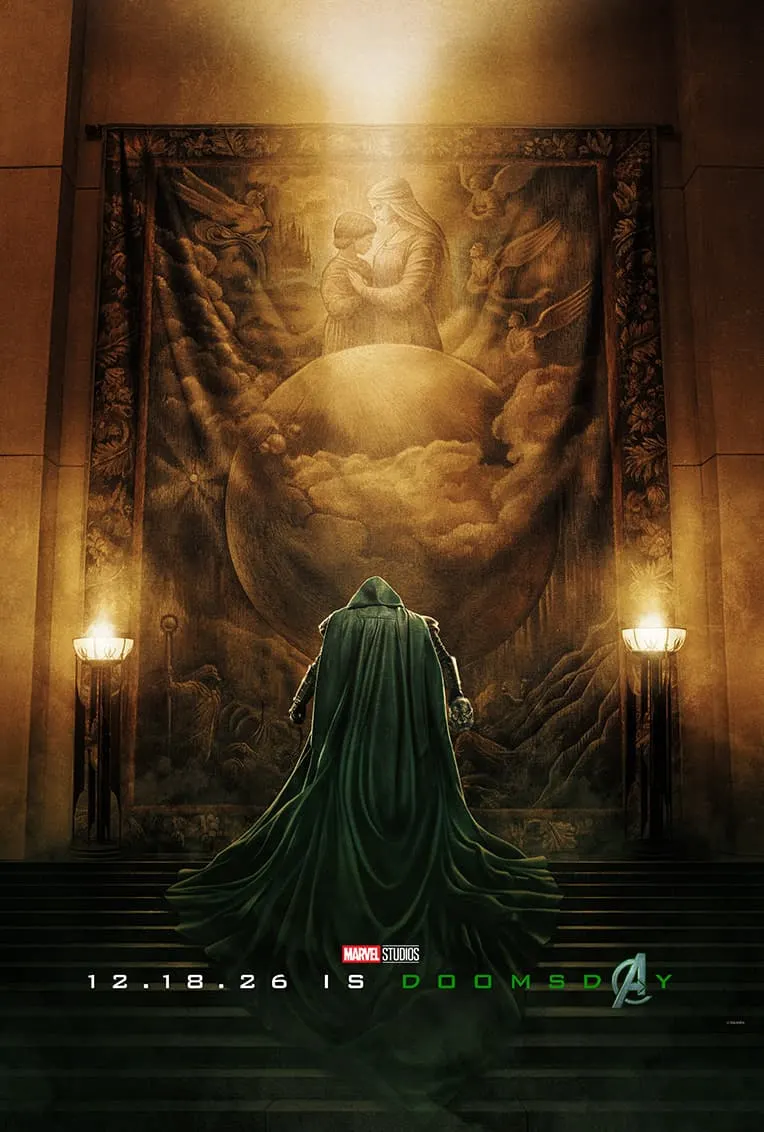
The wait for the Avengers: Doomsday final trailer is over. Released on 23 November 2026, the new footage gives Marvel fans a much clearer sense of the emotional and multiversal stakes behind the next Avengers film. And the most interesting choice is where it begins: not with an army assembling, but with Steve Rogers and Peggy Carter trying to live a quiet life.
That opening matters. After the time-travel ending of Avengers: Endgame, Steve chose a life with Peggy. The trailer brings that decision back into the story and makes it feel less like a closed chapter and more like a part of the larger crisis that is now approaching.
1. Steve Rogers and Peggy Carter are at the emotional centre
Chris Evans returns as Steve Rogers alongside Hayley Atwell as Peggy Carter. The trailer shows the couple in a domestic setting and reveals that they are raising a son. It is a striking way to reintroduce Captain America: the character is not simply being pulled back into another battle; he has a life and a family that can be put at risk.
For viewers, this creates an immediate question. What does Steve stand to lose if he answers the call again? The trailer does not need to explain every detail of the timeline to make that tension clear. It uses the contrast between an ordinary family moment and the arrival of extraordinary visitors to make the stakes personal.
2. The Fantastic Four connect the worlds
The appearance of the Fantastic Four is more than a crowd-pleasing crossover. Pedro Pascal’s Reed Richards, Vanessa Kirby’s Sue Storm, Ebon Moss-Bachrach’s Ben Grimm and Joseph Quinn’s Johnny Storm help connect a corner of Marvel’s universe that has so far existed apart from the central Avengers storyline.
Disney’s official film synopsis describes heroes from three distinct universes being placed on a collision course. That framing is important: Doomsday is not just promising a bigger team-up. It is bringing different worlds, histories and versions of familiar characters into the same conflict.
3. Robert Downey Jr. as Doctor Doom changes the equation
Robert Downey Jr. is back in the Marvel Cinematic Universe, but not as Tony Stark. He plays Victor von Doom, the antagonist at the centre of the film. That casting gives the story an unmistakable layer of dramatic irony. Audiences spent years associating Downey with the hero who helped define the MCU; now the same performer is being positioned as a threat to its heroes.
The key is to let Doom become his own character. Victor von Doom has a distinct identity, history and worldview in Marvel comics. The film will need to establish why this version of Doom is dangerous on his own terms, rather than relying only on the shock of seeing a familiar face in a different role. The trailer’s scale suggests a threat that reaches far beyond a conventional fight between good and evil.
4. The X-Men are no longer just a multiverse tease
The return of legacy X-Men performers gives the trailer another major hook. Patrick Stewart, Ian McKellen, Kelsey Grammer, Rebecca Romijn, Alan Cumming and James Marsden are among the familiar names connected with the film, while Channing Tatum returns as Gambit after his appearance in Deadpool & Wolverine.
For longtime fans, the appeal is obvious. These actors carry decades of screen history with them. But the real opportunity is not simply to place familiar faces in the same frame. It is to give the X-Men a meaningful role in a story about worlds under threat. The trailer’s brief Cyclops moment is designed to land as a recognition beat; the film still has to make the team matter to the central conflict.
5. What the trailer tells us about the Multiverse Saga
Marvel has described Avengers: Doomsday as a collision between heroes from different universes. The final trailer reinforces that direction, bringing the Avengers, Fantastic Four and X-Men into one escalating crisis. It also places the film on the road to Avengers: Secret Wars, currently scheduled for December 2027.
That creates a difficult storytelling challenge. A crossover of this size can easily become a sequence of introductions and cameos. The strongest version of Doomsday will keep the emotional line clear: a family at risk, heroes forced to cooperate, and a villain whose plan threatens more than one world. If the film can make those elements work together, the scale will feel earned.
Avengers: Doomsday release date and confirmed details
- Film: Avengers: Doomsday
- Final trailer: Released 23 November 2026
- Worldwide theatrical release listed by Disney: 18 December 2026
- Directors: Anthony Russo and Joe Russo
- Writer: Stephen McFeely
- Key returning and crossover cast: Robert Downey Jr., Chris Evans, Chris Hemsworth, Pedro Pascal, Anthony Mackie, Florence Pugh, Vanessa Kirby, James Marsden, Patrick Stewart, Ian McKellen and others
Our take: the most promising part is the personal story
It would have been easy for Marvel to sell Avengers: Doomsday only through its enormous cast. Instead, the final trailer puts Steve and Peggy’s life at the front of the pitch, then widens the frame until multiple superhero worlds are in danger. That is a smart move. The MCU’s biggest moments have usually worked best when spectacle is attached to a character choice that audiences understand.
There is still plenty the trailer does not answer: how the different universes connect, what Doom ultimately wants, and how every returning team fits into the same narrative. Those are reasons to be curious, not gaps that a trailer needs to fill. For now, the clearest promise is a Marvel event with a recognisable emotional centre and an unusually broad roster of heroes.
CampyNews verdict: the final trailer makes Avengers: Doomsday feel less like another reunion and more like a collision of legacies. The film now has to deliver the story behind the spectacle.
Sources and further reading
- Disney: Avengers: Doomsday — official film details and release date
- Disney Press: Marvel Studios trailer announcement and cast details
- ABC News: Report on the final trailer
- Entertainment Weekly: Trailer details and returning characters
This is an original CampyNews editorial analysis. It is based on the released trailer and publicly announced film information available at publication time. Interpretations are the author’s own.